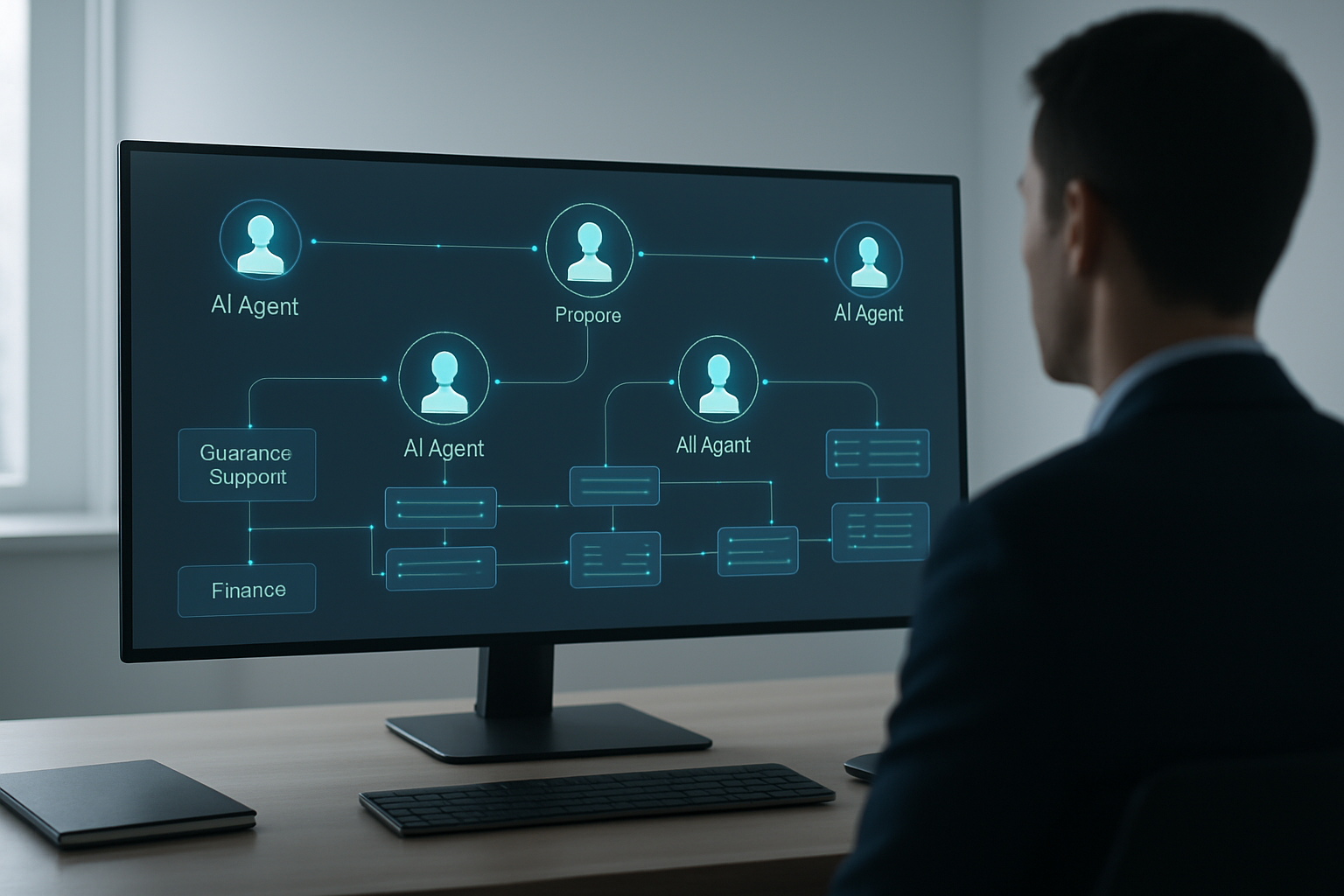
Artificial Intelligence has evolved rapidly over the past few years. While chatbots and virtual assistants have become common, a new generation of AI technology is beginning to attract attention: AI agents.
Unlike traditional AI tools that simply respond to commands, AI agents can perform tasks, make decisions, learn from information, and work toward specific goals with minimal human involvement.
Many experts believe AI agents could become one of the most transformative technologies of the next decade, changing how businesses operate and how people interact with technology.
But what exactly are AI agents, and why are they becoming so important?
What Are AI Agents?
An AI agent is an intelligent software system designed to perform tasks autonomously.
Unlike standard AI models that provide answers when asked, AI agents can take actions, complete workflows, and interact with different systems to achieve specific objectives.
Think of an AI agent as a digital worker rather than a digital assistant.
For example, instead of simply answering questions about customer support, an AI agent could:
- Analyze customer issues
- Access databases
- Generate solutions
- Send responses automatically
- Escalate problems when needed
This ability to act independently is what makes AI agents unique.
How AI Agents Work
AI agents typically combine several technologies:
Natural Language Processing
Allows agents to understand and communicate using human language.
Machine Learning
Helps agents learn from data and improve performance over time.
Decision-Making Systems
Enable agents to evaluate options and select the best course of action.
Automation Tools
Allow agents to interact with software applications and complete tasks.
Together, these capabilities enable AI agents to operate with a high degree of autonomy.
Types of AI Agents
AI agents can vary in complexity.
Simple Agents
These agents follow predefined rules and perform specific tasks.
Learning Agents
Learning agents improve their performance based on experience and feedback.
Autonomous Agents
These advanced agents can make decisions independently and adapt to changing environments.
As AI technology advances, autonomous agents are becoming increasingly capable.
Why AI Agents Matter
AI agents are important because they go beyond automation.
Traditional automation follows fixed instructions. AI agents can analyze situations, adapt to changes, and make intelligent decisions.
This creates opportunities for businesses to increase productivity and reduce operational costs.
Improved Efficiency
AI agents can handle repetitive tasks faster than humans.
24/7 Availability
Unlike human workers, AI agents can operate continuously without breaks.
Better Decision-Making
AI agents can analyze large amounts of information quickly and identify valuable insights.
Cost Reduction
Businesses can automate processes that would otherwise require significant human resources.
Real-World Applications of AI Agents
AI agents are already being used across many industries.
Customer Support
AI agents can answer questions, resolve issues, and improve customer experiences.
Healthcare
Medical AI agents assist with diagnostics, patient monitoring, and administrative tasks.
Finance
Financial institutions use AI agents for fraud detection, risk analysis, and customer service.
E-Commerce
AI agents recommend products, manage inventory, and support customers throughout the buying process.
Software Development
Developers are increasingly using AI agents to write code, identify bugs, and improve productivity.
AI Agents and the Future of Work
One of the biggest discussions surrounding AI agents is their impact on employment.
Some repetitive tasks may become automated, reducing the need for manual work in certain areas.
However, AI agents are also expected to create new opportunities.
Future professionals may focus more on:
- Managing AI systems
- Strategic decision-making
- Creative problem-solving
- Human-centered roles
Rather than replacing all jobs, AI agents are likely to change how work is performed.
Challenges Facing AI Agents
Despite their potential, AI agents face several challenges.
Privacy Concerns
AI agents often require access to large amounts of data.
Security Risks
Autonomous systems could become targets for cyberattacks.
Ethical Questions
Businesses must ensure AI agents make fair and responsible decisions.
Reliability
AI agents may still make mistakes and require human oversight.
Addressing these challenges will be essential for widespread adoption.
The Future of AI Agents
The future of AI agents looks extremely promising.
As technology improves, AI agents are expected to become more intelligent, reliable, and capable of handling complex tasks.
Future developments may include:
- Fully autonomous digital assistants
- AI-powered business operations
- Advanced research agents
- Intelligent personal productivity systems
- Multi-agent collaboration networks
Many technology leaders believe AI agents will become as important as smartphones and cloud computing have been in previous decades.
Final Thoughts
AI agents represent the next major step in the evolution of artificial intelligence. Unlike traditional AI systems that simply respond to requests, AI agents can act independently, solve problems, and complete tasks with minimal human involvement.
Their ability to improve efficiency, reduce costs, and support decision-making makes them valuable for businesses across virtually every industry.
While challenges related to security, ethics, and reliability remain, the rise of AI agents is already reshaping the future of work and technology. As adoption continues to grow, AI agents are likely to become a fundamental part of the digital world in the years ahead.