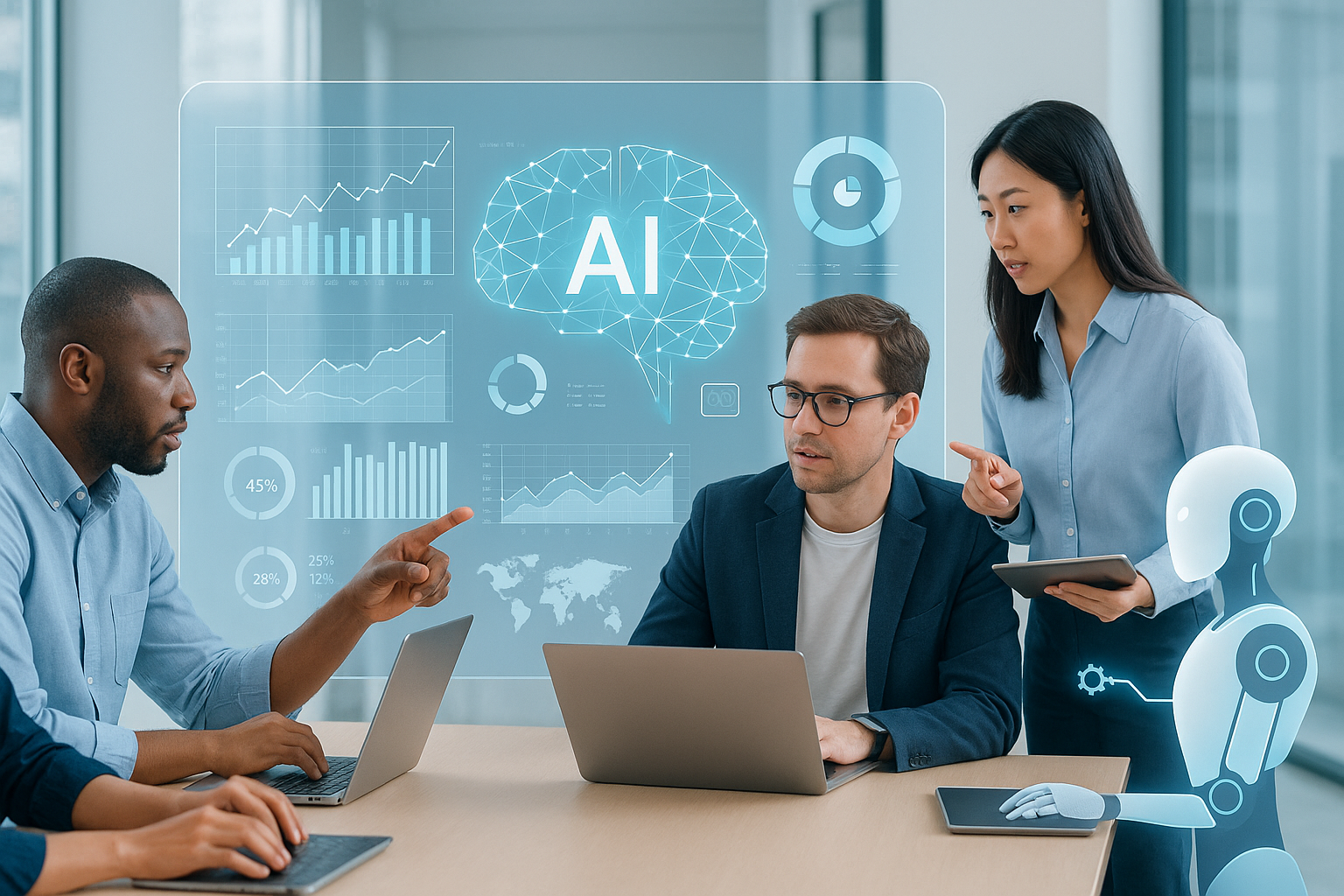
Artificial Intelligence (AI) is no longer a futuristic concept—it has become a part of our daily lives. From virtual assistants and recommendation systems to automated customer support and content generation, AI is transforming the way people work and communicate. However, one of the biggest misconceptions about AI is that it will completely replace humans in the workplace.
In reality, the future is more likely to be defined by collaboration rather than competition. Instead of replacing human workers, AI is expected to become a powerful partner that enhances creativity, improves productivity, and supports better decision-making. The most successful organizations of the future may not be those that rely only on AI or only on human expertise, but those that effectively combine both.
As technology continues to evolve, understanding the future of human-AI collaboration will be essential for businesses, professionals, and students preparing for tomorrow’s digital economy.
Understanding Human-AI Collaboration
Human-AI collaboration refers to the process where people and artificial intelligence systems work together to achieve better outcomes than either could accomplish alone.
Humans bring creativity, emotional intelligence, ethical judgment, and critical thinking to the table. AI contributes speed, automation, data analysis, and pattern recognition.
When combined effectively, these strengths create a partnership that can solve complex problems more efficiently and accurately.
Rather than viewing AI as a replacement for human talent, many experts now see it as a tool that amplifies human capabilities.
Why Collaboration Matters
Modern businesses generate enormous amounts of data every day. Analyzing this information manually would be slow and inefficient.
AI can process large datasets within seconds, identify trends, and generate useful insights. Humans can then interpret those insights, make strategic decisions, and apply context that machines may not fully understand.
This balance allows organizations to make smarter decisions while maintaining human oversight.
Collaboration also reduces repetitive work, allowing employees to focus on innovation, relationship building, and high-value tasks.
AI as a Productivity Partner
One of AI’s greatest strengths is its ability to automate routine activities.
Employees spend significant time on repetitive tasks such as data entry, scheduling, document organization, and report generation. AI-powered tools can complete many of these activities automatically, saving valuable time.
Instead of replacing workers, automation allows professionals to focus on responsibilities that require creativity, communication, and problem-solving.
For businesses, this often leads to improved efficiency and lower operational costs.
Human Creativity Remains Essential
Although AI can generate text, images, code, and recommendations, it still depends on patterns learned from existing data.
Humans remain uniquely capable of original thinking, emotional storytelling, strategic planning, and innovation driven by personal experience.
For example, a marketing team may use AI to analyze customer behavior and generate campaign ideas, but human professionals still decide the overall brand message and creative direction.
The combination of AI-generated insights and human creativity often produces stronger results than either could achieve independently.
Collaboration in Healthcare
Healthcare is one of the industries where human-AI collaboration is already making a significant impact.
AI systems can analyze medical images, detect patterns in patient records, and identify potential health risks quickly.
However, final diagnoses and treatment decisions still rely on doctors who consider patient history, emotions, ethics, and complex medical judgment.
By working together, AI and healthcare professionals can improve accuracy while delivering more personalized patient care.
Transforming Education
Education is also benefiting from collaborative AI technologies.
AI-powered learning platforms can personalize lessons based on a student’s progress, strengths, and weaknesses.
Teachers can use these insights to provide targeted guidance and spend more time supporting students individually.
Instead of replacing educators, AI acts as an intelligent assistant that helps create better learning experiences.
Human-AI Collaboration in Business
Businesses across industries are adopting AI to improve operations and decision-making.
Examples include:
- Customer service assistants that support human agents
- Financial analysis tools that identify market trends
- Recruitment platforms that screen job applications
- Sales systems that predict customer preferences
- Project management software that automates routine tasks
In each case, AI performs data-heavy work while humans make final decisions and build relationships.
This partnership allows companies to operate more efficiently without losing the human touch.
Ethical and Trust Considerations
As AI becomes more integrated into workplaces, ethical concerns become increasingly important.
Organizations must ensure that AI systems operate fairly, protect user privacy, and avoid biased decision-making.
Human oversight remains essential because AI models can occasionally produce incorrect or misleading results.
Transparent policies and responsible AI governance will help maintain trust between businesses, employees, and customers.
The future of collaboration depends not only on technological advancement but also on ethical implementation.
New Skills for the Future Workforce
As AI continues evolving, the skills required in the workplace will also change.
Professionals who can effectively work alongside AI systems may have significant advantages in the job market.
Important future skills include:
- Critical thinking
- Digital literacy
- AI tool management
- Creativity
- Communication
- Adaptability
- Data interpretation
- Problem-solving
Rather than competing against AI, individuals who learn to use it effectively will likely become more productive and valuable.
Challenges of Human-AI Collaboration
Despite its benefits, collaboration between humans and AI is not without challenges.
Overreliance on Automation
Excessive dependence on AI could reduce human judgment and critical thinking.
Data Privacy
AI systems often require access to large amounts of personal or business data.
Job Evolution
Some routine roles may change significantly as automation increases.
Trust and Transparency
Employees and customers need confidence that AI-generated recommendations are accurate and fair.
Addressing these concerns requires ongoing education, regulation, and responsible technology development.
The Next Decade of Collaboration
The future of human-AI collaboration is expected to become even more advanced.
AI systems may evolve into intelligent workplace assistants capable of handling research, scheduling, documentation, analytics, and routine decision support.
Humans will increasingly focus on leadership, innovation, strategic planning, emotional intelligence, and complex problem-solving.
Industries such as healthcare, finance, education, engineering, law, manufacturing, and creative media are all likely to see deeper collaboration between people and AI technologies.
Rather than replacing professionals, AI will become a trusted partner that expands what humans can accomplish.
Final Thoughts
The future of artificial intelligence is not about machines replacing people—it is about creating stronger partnerships between human intelligence and machine capabilities.
AI excels at processing data, recognizing patterns, and automating repetitive work, while humans contribute creativity, empathy, ethical reasoning, and strategic thinking. Together, these complementary strengths can unlock new levels of productivity and innovation across nearly every industry.
As businesses and individuals adapt to this changing landscape, the ability to collaborate effectively with AI will become one of the most valuable skills of the digital age. Those who embrace this partnership are likely to lead the next wave of technological and economic progress.